Leben in der Demokratie: alle 150 Fragen mit Antworten
Topic "Living in a democracy" — every official question with the correct answer highlighted and an English explanation.
Frage 1
In Deutschland dürfen Menschen offen etwas gegen die Regierung sagen, weil …
- A.hier Religionsfreiheit gilt.
- B.die Menschen Steuern zahlen.
- C.die Menschen das Wahlrecht haben.
- D.hier Meinungsfreiheit gilt.
Explanation (English)
Freedom of speech (Meinungsfreiheit) is one of the most important fundamental rights guaranteed by Article 5 of the German Basic Law (Grundgesetz). It means every person in Germany has the right to freely express their opinions in speech, writing, and images — including criticism of the government. This right is essential to a functioning democracy.
Frage 2
In Deutschland können Eltern bis zum 14. Lebensjahr ihres Kindes entscheiden, ob es in der Schule am …
- A.Geschichtsunterricht teilnimmt.
- B.Religionsunterricht teilnimmt.
- C.Politikunterricht teilnimmt.
- D.Sprachunterricht teilnimmt.
Explanation (English)
Under German law, parents have the right to decide whether their child participates in religious education at school until the child turns 14. After age 14, the child can decide for themselves whether to attend religious classes (this is called "Religionsmündigkeit" — religious maturity). All other school subjects like history, politics, and languages are mandatory.
Frage 3
Deutschland ist ein Rechtsstaat. Was ist damit gemeint?
- A.Alle Einwohnerinnen/Einwohner und der Staat müssen sich an die Gesetze halten.
- B.Der Staat muss sich nicht an die Gesetze halten.
- C.Nur Deutsche müssen die Gesetze befolgen.
- D.Die Gerichte machen die Gesetze.
Explanation (English)
The term "Rechtsstaat" (rule of law / constitutional state) means that the government itself is bound by the law — it cannot act arbitrarily. Everyone, including the state and all its institutions, must follow the law. This principle is a cornerstone of German democracy and is established in the Basic Law.
Frage 4
Welches Recht gehört zu den Grundrechten in Deutschland?
- A.Waffenbesitz
- B.Faustrecht
- C.Meinungsfreiheit
- D.Selbstjustiz
Explanation (English)
Freedom of expression (Meinungsfreiheit) is a fundamental right protected by Article 5 of the Basic Law. The other options — the right to bear arms, vigilantism (literally "fist law"), and self-help justice — are not fundamental rights in Germany. In fact, vigilantism and self-help justice are illegal. Germany does not have a constitutional right to bear arms like the United States.
Frage 5
Wahlen in Deutschland sind frei. Was bedeutet das?
- A.Man darf Geld annehmen, wenn man dafür eine bestimmte Kandidatin/einen bestimmten Kandidaten wählt.
- B.Nur Personen, die noch nie im Gefängnis waren, dürfen wählen.
- C.Die Wählerin/der Wähler darf bei der Wahl weder beeinflusst noch zu einer bestimmten Stimmabgabe gezwungen werden und keine Nachteile durch die Wahl haben.
- D.Alle wahlberechtigten Personen müssen wählen.
Explanation (English)
German elections follow five principles: they are universal, direct, free, equal, and secret (allgemein, unmittelbar, frei, gleich, geheim). "Free" means voters cannot be pressured, bribed, or forced to vote in any particular way. There is no compulsory voting in Germany — voting is a right, not an obligation. Accepting money for votes is illegal.
Frage 6
Wie heißt die deutsche Verfassung?
- A.Volksgesetz
- B.Bundesgesetz
- C.Deutsches Gesetz
- D.Grundgesetz
Explanation (English)
The German constitution is called the "Grundgesetz" (Basic Law). It was adopted on May 23, 1949 and was originally intended as a temporary constitution for West Germany until reunification. After reunification in 1990, it became the constitution for all of Germany. It was deliberately not called "Verfassung" (constitution) to emphasize its provisional nature, but today it functions fully as Germany's constitution.
Frage 7
Welches Recht gehört zu den Grundrechten, die nach der deutschen Verfassung garantiert werden? Das Recht auf …
- A.Glaubens- und Gewissensfreiheit
- B.Unterhaltung
- C.Arbeit
- D.Wohnung
Explanation (English)
Freedom of faith and conscience (Article 4 of the Basic Law) is a fundamental right in Germany. While the right to work and housing are important societal goals, they are not guaranteed as fundamental rights in the Basic Law. The right to entertainment is not a constitutional right at all.
Frage 8
Was steht nicht im Grundgesetz von Deutschland?
- A.Die Würde des Menschen ist unantastbar.
- B.Alle sollen gleich viel Geld haben.
- C.Jeder Mensch darf seine Meinung sagen.
- D.Alle sind vor dem Gesetz gleich.
Explanation (English)
The Basic Law guarantees human dignity (Article 1), freedom of expression (Article 5), and equality before the law (Article 3). However, it does NOT guarantee that everyone should have the same amount of money. Germany has a social market economy which allows for economic differences while providing a social safety net.
Frage 9
Welches Grundrecht gilt in Deutschland nur für Ausländerinnen/Ausländer? Das Grundrecht auf …
- A.Schutz der Familie
- B.Menschenwürde
- C.Asyl
- D.Meinungsfreiheit
Explanation (English)
The right to asylum (Article 16a of the Basic Law) is the only fundamental right that applies exclusively to foreigners. It gives politically persecuted people the right to seek protection in Germany. All other listed rights — family protection, human dignity, and freedom of opinion — apply to all people in Germany, regardless of nationality.
Frage 10
Was ist mit dem deutschen Grundgesetz vereinbar?
- A.die Prügelstrafe
- B.die Folter
- C.die Todesstrafe
- D.die Geldstrafe
Explanation (English)
Among the listed options, only fines (Geldstrafe) are compatible with the Basic Law. Corporal punishment, torture, and the death penalty are all prohibited. Article 102 explicitly states: "The death penalty is abolished." Article 1 (human dignity) and Article 104 prohibit torture and physical punishment by the state.
Frage 11
Wie wird die Verfassung der Bundesrepublik Deutschland genannt?
- A.Grundgesetz
- B.Bundesverfassung
- C.Gesetzbuch
- D.Verfassungsvertrag
Explanation (English)
This question is similar to Question 6. The German constitution is called the "Grundgesetz" (Basic Law). It was enacted in 1949 and serves as the supreme law of Germany. All other laws must comply with the Basic Law, and the Federal Constitutional Court (Bundesverfassungsgericht) ensures this.
Frage 12
Eine Partei im Deutschen Bundestag will die Pressefreiheit abschaffen. Ist das möglich?
- A.Ja, wenn mehr als die Hälfte der Abgeordneten im Bundestag dafür sind.
- B.Ja, aber dazu müssen zwei Drittel der Abgeordneten im Bundestag dafür sein.
- C.Nein, denn die Pressefreiheit ist ein Grundrecht. Sie kann nicht abgeschafft werden.
- D.Nein, denn nur der Bundesrat kann die Pressefreiheit abschaffen.
Explanation (English)
Press freedom is guaranteed by Article 5 of the Basic Law and is protected by the "eternity clause" (Ewigkeitsklausel, Article 79 Paragraph 3). This clause means that certain core principles of the Basic Law — including fundamental rights like press freedom — can never be abolished or changed, not even with a unanimous vote in parliament.
Frage 13
Im Parlament steht der Begriff "Opposition" für …
- A.die regierenden Parteien.
- B.die Fraktion mit den meisten Abgeordneten.
- C.alle Parteien, die bei der letzten Wahl die 5%-Hürde erreichen konnten.
- D.alle Abgeordneten, die nicht zu der Regierungspartei/den Regierungsparteien gehören.
Explanation (English)
The opposition consists of all parties and their members in parliament who are not part of the government coalition. The opposition plays a crucial role in German democracy: it monitors the government, proposes alternatives, and holds the ruling parties accountable. A strong opposition is considered essential for a healthy democracy.
Frage 14
Meinungsfreiheit in Deutschland heißt, dass ich …
- A.Passanten auf der Straße beschimpfen darf.
- B.meine Meinung im Internet äußern kann.
- C.Nazi-, Hamas- oder Islamischer Staat-Symbole öffentlich tragen darf.
- D.meine Meinung nur dann äußern darf, solange ich der Regierung nicht widerspreche.
Explanation (English)
Freedom of speech means you can express your opinions freely, including on the internet and even against the government. However, this right has limits: you cannot insult individuals (that is a criminal offense called "Beleidigung"), and displaying symbols of banned organizations like the Nazis, Hamas, or ISIS is illegal in Germany. Note that this question was updated to include Hamas and Islamic State references in recent catalog versions.
Frage 15
Was verbietet das deutsche Grundgesetz?
- A.Militärdienst
- B.Zwangsarbeit
- C.freie Berufswahl
- D.Arbeit im Ausland
Explanation (English)
The Basic Law explicitly prohibits forced labor (Zwangsarbeit) in Article 12. Military service, free choice of profession, and working abroad are all permitted. In fact, free choice of profession is itself a fundamental right (Article 12). Germany historically experienced forced labor during the Nazi era, which is why this prohibition is explicitly stated.
Frage 16
Wann ist die Meinungsfreiheit in Deutschland eingeschränkt?
- A.bei der öffentlichen Verbreitung falscher Behauptungen über einzelne Personen
- B.bei Meinungsäußerungen über die Bundesregierung
- C.bei Diskussionen über Religionen
- D.bei Kritik am Staat
Explanation (English)
While freedom of speech is a fundamental right, it has limits. Spreading false claims about specific individuals (defamation/slander) can be a criminal offense. However, criticizing the government, discussing religions, or criticizing the state are all protected by freedom of speech. The balance between free speech and personal rights is an important principle in German law.
Frage 17
Die deutschen Gesetze verbieten …
- A.Meinungsfreiheit der Einwohnerinnen und Einwohner.
- B.Petitionen der Bürgerinnen und Bürger.
- C.Versammlungsfreiheit der Einwohnerinnen und Einwohner.
- D.Ungleichbehandlung der Bürgerinnen und Bürger durch den Staat.
Explanation (English)
German law prohibits the state from treating citizens unequally (discrimination). This is established in Article 3 of the Basic Law: "All persons are equal before the law." Freedom of opinion, the right to petition, and freedom of assembly are all protected rights — they are NOT prohibited.
Frage 18
Welches Grundrecht ist in Artikel 1 des Grundgesetzes der Bundesrepublik Deutschland garantiert?
- A.die Unantastbarkeit der Menschenwürde
- B.das Recht auf Leben
- C.Religionsfreiheit
- D.Meinungsfreiheit
Explanation (English)
Article 1 of the Basic Law states: "Die Würde des Menschen ist unantastbar" — "Human dignity shall be inviolable." This is the most important article in the entire constitution and is protected by the eternity clause (it can never be changed or removed). The right to life is in Article 2, freedom of religion in Article 4, and freedom of expression in Article 5.
Frage 19
Was versteht man unter dem Recht der "Freizügigkeit" in Deutschland?
- A.Man darf sich seinen Wohnort selbst aussuchen.
- B.Man kann seinen Beruf wechseln.
- C.Man darf sich für eine andere Religion entscheiden.
- D.Man darf sich in der Öffentlichkeit nur leicht bekleidet bewegen.
Explanation (English)
"Freizügigkeit" (freedom of movement, Article 11 of the Basic Law) means that German citizens have the right to freely choose where to live and work within Germany. This was historically significant because in the GDR (East Germany), citizens were not free to choose their residence or travel freely. The right to change professions is covered by Article 12 (freedom of occupation).
Frage 20
Eine Partei in Deutschland verfolgt das Ziel, eine Diktatur zu errichten. Sie ist dann …
- A.tolerant.
- B.rechtsstaatlich orientiert.
- C.gesetzestreu.
- D.verfassungswidrig.
Explanation (English)
Any party that aims to establish a dictatorship is unconstitutional (verfassungswidrig). The Basic Law protects Germany's democratic order, and Article 21 allows the Federal Constitutional Court to ban parties that seek to undermine or abolish the free democratic basic order. This provision exists because of Germany's experience with the Nazi party, which used democratic processes to destroy democracy itself.
Frage 21
Welches ist das Wappen der Bundesrepublik Deutschland?
- A.Bild 1
- B.Bild 2
- C.Bild 3
- D.Bild 4
Explanation (English)
The coat of arms of Germany (Bundeswappen) features a black eagle with red beak and claws on a golden (yellow) shield. The eagle has been a symbol of German sovereignty for centuries, dating back to the Holy Roman Empire. The current design was adopted in 1950 for the Federal Republic of Germany.
Frage 22
Was für eine Staatsform hat Deutschland?
- A.Monarchie
- B.Diktatur
- C.Republik
- D.Fürstentum
Explanation (English)
Germany is a republic, meaning its head of state (the Federal President) is elected, not a hereditary monarch. Germany became a republic in 1918 when Kaiser Wilhelm II abdicated at the end of World War I. The Weimar Republic was followed by the Nazi dictatorship, and after WWII, the Federal Republic of Germany was established in 1949.
Frage 23
In Deutschland sind die meisten Erwerbstätigen …
- A.in kleinen Familienunternehmen beschäftigt.
- B.ehrenamtlich für ein Bundesland tätig.
- C.selbstständig mit einer eigenen Firma tätig.
- D.bei einer Firma oder Behörde beschäftigt.
Explanation (English)
The vast majority of working people in Germany are employees (Arbeitnehmer) working for companies or government agencies. While small family businesses and self-employment exist, most people are in regular employment relationships with companies, institutions, or public authorities. Volunteering (Ehrenamt) is unpaid and not counted as employment.
Frage 24
Wie viele Bundesländer hat die Bundesrepublik Deutschland?
- A.14
- B.15
- C.16
- D.17
Explanation (English)
Germany consists of 16 federal states (Bundesländer): Baden-Württemberg, Bavaria, Berlin, Brandenburg, Bremen, Hamburg, Hesse, Mecklenburg-Western Pomerania, Lower Saxony, North Rhine-Westphalia, Rhineland-Palatinate, Saarland, Saxony, Saxony-Anhalt, Schleswig-Holstein, and Thuringia. Three of these (Berlin, Hamburg, Bremen) are city-states (Stadtstaaten).
Frage 25
Was ist kein Bundesland der Bundesrepublik Deutschland?
- A.Elsass-Lothringen
- B.Nordrhein-Westfalen
- C.Mecklenburg-Vorpommern
- D.Sachsen-Anhalt
Explanation (English)
Alsace-Lorraine (Elsass-Lothringen) is not a German federal state — it is a region in France. It was part of Germany from 1871 to 1918 and again during the Nazi occupation (1940–1945), but has been French territory since the end of WWII. All the other options are legitimate German federal states.
Bereit für den Ernstfall? Test yourself under real exam conditions.
Mock exams with 33 questions in 60 minutes, progress tracking and weak-area drills come with the Learning Pass.
Frage 26
Deutschland ist …
- A.eine kommunistische Republik.
- B.ein demokratischer und sozialer Bundesstaat.
- C.eine kapitalistische und soziale Monarchie.
- D.ein sozialer und sozialistischer Bundesstaat.
Explanation (English)
Article 20 of the Basic Law defines Germany as a "demokratischer und sozialer Bundesstaat" — a democratic and social federal state. This means Germany is democratic (power comes from the people), social (the state provides for those in need), and federal (power is shared between the central government and the 16 states). Germany is neither communist, monarchist, nor socialist.
Frage 27
Deutschland ist …
- A.ein sozialistischer Staat.
- B.ein Bundesstaat.
- C.eine Diktatur.
- D.eine Monarchie.
Explanation (English)
Germany is a federal state (Bundesstaat), meaning it is composed of several partially sovereign states (Bundesländer) that share power with the central government. The GDR (East Germany) was a socialist state, but unified Germany is not. Germany has not been a monarchy since 1918 and has not been a dictatorship since 1945.
Frage 28
Wer wählt in Deutschland die Abgeordneten zum Bundestag?
- A.das Militär
- B.die Wirtschaft
- C.das wahlberechtigte Volk
- D.die Verwaltung
Explanation (English)
Members of the Bundestag (German parliament) are elected directly by the eligible voters (wahlberechtigtes Volk). Every German citizen aged 18 or older has the right to vote in federal elections. Elections are held every four years. The military, business sector, and government administration have no special role in electing parliament members.
Frage 29
Welches Tier ist das Wappentier der Bundesrepublik Deutschland?
- A.Löwe
- B.Adler
- C.Bär
- D.Pferd
Explanation (English)
The eagle (Adler) is the heraldic animal of Germany, known as the "Bundesadler" (Federal Eagle). It has been a symbol of German authority since the Holy Roman Empire. The Berlin bear is the symbol of the city of Berlin, the lion appears on the coat of arms of several German states (like Bavaria and Hesse), and the horse is the symbol of Lower Saxony.
Frage 30
Was ist kein Merkmal unserer Demokratie?
- A.regelmäßige Wahlen
- B.Pressezensur
- C.Meinungsfreiheit
- D.verschiedene Parteien
Explanation (English)
Press censorship (Pressezensur) is NOT a feature of democracy — it is the opposite. In a democracy, the press must be free to report without government censorship. Regular elections, freedom of opinion, and multiple parties are all essential features of a functioning democracy. Press freedom is specifically protected by Article 5 of the Basic Law.
Frage 31
Die Zusammenarbeit von Parteien zur Bildung einer Regierung nennt man in Deutschland …
- A.Einheit.
- B.Koalition.
- C.Ministerium.
- D.Fraktion.
Explanation (English)
When two or more parties work together to form a government, this alliance is called a "Koalition" (coalition). Since no single party usually wins an absolute majority in German elections, coalitions are very common. The parties negotiate a coalition agreement (Koalitionsvertrag) that outlines their shared political goals. A "Fraktion" is a parliamentary group of one party, and a "Ministerium" is a government ministry.
Frage 32
Was ist keine staatliche Gewalt in Deutschland?
- A.Gesetzgebung
- B.Regierung
- C.Presse
- D.Rechtsprechung
Explanation (English)
Germany has three branches of government (Gewaltenteilung): Legislative (Gesetzgebung — makes laws, e.g., Bundestag), Executive (Regierung — enforces laws, e.g., government/police), and Judiciary (Rechtsprechung — interprets laws, e.g., courts). The press is NOT a branch of state power. However, the media is sometimes informally called the "fourth estate" (vierte Gewalt) because of its important watchdog role.
Frage 33
Welche Aussage ist richtig? In Deutschland …
- A.sind Staat und Religionsgemeinschaften voneinander getrennt.
- B.bilden die Religionsgemeinschaften den Staat.
- C.ist der Staat abhängig von den Religionsgemeinschaften.
- D.bilden Staat und Religionsgemeinschaften eine Einheit.
Explanation (English)
Germany practices separation of church and state. While Germany is not as strictly secular as France (churches can collect taxes through the state, and religious education is offered in public schools), the state and religious communities are constitutionally separate. No religion has governmental authority, and the state does not favor any particular religion.
Frage 34
Was ist Deutschland nicht?
- A.eine Demokratie
- B.ein Rechtsstaat
- C.eine Monarchie
- D.ein Sozialstaat
Explanation (English)
Germany is NOT a monarchy. It is a democracy, a constitutional state (Rechtsstaat), and a welfare state (Sozialstaat). Germany ended its monarchy in 1918 when Kaiser Wilhelm II abdicated at the end of World War I. Since then, Germany has been a republic with an elected head of state (the Federal President).
Frage 35
Womit finanziert der deutsche Staat die Sozialversicherung?
- A.Kirchensteuer
- B.Sozialabgaben
- C.Spendengeldern
- D.Vereinsbeiträgen
Explanation (English)
Social insurance in Germany is financed through social security contributions (Sozialabgaben), which are automatically deducted from employees' gross salaries. Both employers and employees contribute approximately equal shares. These contributions fund health insurance, pension insurance, unemployment insurance, long-term care insurance, and accident insurance. Church tax is a separate voluntary payment, and donations/membership fees play no role in public social insurance.
Frage 36
Welche Maßnahme schafft in Deutschland soziale Sicherheit?
- A.die Krankenversicherung
- B.die Autoversicherung
- C.die Gebäudeversicherung
- D.die Haftpflichtversicherung
Explanation (English)
Health insurance (Krankenversicherung) is part of the German social security system (Sozialversicherung). It is mandatory for all residents of Germany. Car insurance, property insurance, and liability insurance are private insurances that protect against specific risks but are not part of the social security system. Germany's social insurance has five pillars: health, pension, unemployment, long-term care, and accident insurance.
Frage 37
Wie werden die Regierungschefinnen/Regierungschefs der meisten Bundesländer in Deutschland genannt?
- A.Erste Ministerin/Erster Minister
- B.Premierministerin/Premierminister
- C.Senatorin/Senator
- D.Ministerpräsidentin/Ministerpräsident
Explanation (English)
The heads of government in most German federal states are called "Ministerpräsident/in" (Minister-President). The exceptions are the three city-states: Berlin's head of government is the "Regierende/r Bürgermeister/in" (Governing Mayor), Hamburg's is the "Erste/r Bürgermeister/in" (First Mayor), and Bremen's is the "Präsident/in des Senats und Bürgermeister/in" (President of the Senate and Mayor).
Frage 38
Die Bundesrepublik Deutschland ist ein demokratischer und sozialer …
- A.Staatenverbund.
- B.Bundesstaat.
- C.Staatenbund.
- D.Zentralstaat.
Explanation (English)
As stated in Article 20 of the Basic Law, Germany is a "demokratischer und sozialer Bundesstaat" (democratic and social federal state). A Bundesstaat (federal state) is different from a Staatenbund (confederation — a loose alliance of independent states like the EU) and a Zentralstaat (centralized/unitary state like France). In a federal state, power is shared between a central government and regional governments.
Frage 39
Was hat jedes deutsche Bundesland?
- A.eine eigene Außenministerin/einen eigenen Außenminister
- B.eine eigene Währung
- C.eine eigene Armee
- D.eine eigene Regierung
Explanation (English)
Each German federal state has its own state government (Landesregierung), led by a Minister-President, with its own state parliament (Landtag) and state constitution. However, states do NOT have their own foreign ministers (foreign policy is a federal matter), their own currency (Germany uses the Euro throughout), or their own military (the Bundeswehr is the sole military force for all of Germany).
Frage 40
Mit welchen Worten beginnt die deutsche Nationalhymne?
- A.Völker, hört die Signale …
- B.Einigkeit und Recht und Freiheit …
- C.Freude schöner Götterfunken …
- D.Deutschland einig Vaterland …
Explanation (English)
The German national anthem uses only the third verse of the "Deutschlandlied" (Song of Germany), written by August Heinrich Hoffmann von Fallersleben in 1841. It begins with "Einigkeit und Recht und Freiheit" (Unity and justice and freedom). "Freude schöner Götterfunken" is from Beethoven's "Ode to Joy" (the EU anthem). "Völker, hört die Signale" is from "The Internationale" (a socialist anthem). "Deutschland einig Vaterland" was from the GDR national anthem.
Frage 41
Warum gibt es in einer Demokratie mehr als eine Partei?
- A.weil dadurch die unterschiedlichen Meinungen der Bürgerinnen und Bürger vertreten werden
- B.damit Bestechung in der Politik begrenzt wird
- C.um politische Demonstrationen zu verhindern
- D.um wirtschaftlichen Wettbewerb anzuregen
Explanation (English)
Multiple parties exist in a democracy to represent the diversity of opinions and interests among citizens. Different groups of people have different values, priorities, and political views, and parties serve as vehicles for channeling these views into the political process. A one-party system would not represent this diversity and is characteristic of authoritarian regimes.
Frage 42
Wer beschließt in Deutschland ein neues Gesetz?
- A.die Regierung
- B.das Parlament
- C.die Gerichte
- D.die Polizei
Explanation (English)
New laws in Germany are enacted by parliament (the Bundestag, often with participation of the Bundesrat). While the government can propose laws, only parliament has the authority to pass them through a vote. Courts interpret and apply laws but do not create them. The police enforce laws but have no legislative power. This separation of powers is a fundamental principle of the Rechtsstaat.
Frage 43
Wann kann in Deutschland eine Partei verboten werden?
- A.wenn ihr Wahlkampf zu teuer ist
- B.wenn sie gegen die Verfassung kämpft
- C.wenn sie Kritik am Staatsoberhaupt äußert
- D.wenn ihr Programm eine neue Richtung vorschlägt
Explanation (English)
A party can only be banned in Germany if it actively seeks to undermine or abolish the free democratic basic order (freiheitliche demokratische Grundordnung). Only the Federal Constitutional Court (Bundesverfassungsgericht) can ban a party — no other body has this authority. Criticizing politicians, proposing new policies, or spending money on campaigns are all legitimate political activities. A notable recent example was the banning attempt against the NPD.
Frage 44
Wen kann man als Bürgerin/Bürger in Deutschland nicht direkt wählen?
- A.Abgeordnete des EU-Parlaments
- B.Die Bundespräsidentin/den Bundespräsidenten
- C.Landtagsabgeordnete
- D.Bundestagsabgeordnete
Explanation (English)
German citizens cannot directly elect the Federal President (Bundespräsident/in). The President is elected by the Federal Convention (Bundesversammlung), a special body consisting of all Bundestag members plus an equal number of delegates chosen by the state parliaments. Citizens directly elect members of the Bundestag, state parliaments (Landtage), and the European Parliament.
Frage 45
Zu welcher Versicherung gehört die Pflegeversicherung?
- A.Sozialversicherung
- B.Unfallversicherung
- C.Hausratsversicherung
- D.Haftpflicht- und Feuerversicherung
Explanation (English)
Long-term care insurance (Pflegeversicherung) is one of the five pillars of the German social insurance system (Sozialversicherung). The five pillars are: health insurance (Krankenversicherung), pension insurance (Rentenversicherung), unemployment insurance (Arbeitslosenversicherung), long-term care insurance (Pflegeversicherung), and accident insurance (Unfallversicherung). Home contents insurance and liability insurance are private, voluntary insurances.
Frage 46
Der deutsche Staat hat viele Aufgaben. Welche Aufgabe gehört dazu?
- A.Er baut Straßen und Schulen.
- B.Er verkauft Lebensmittel und Kleidung.
- C.Er versorgt alle Einwohnerinnen und Einwohner kostenlos mit Zeitungen.
- D.Er produziert Autos und Busse.
Explanation (English)
Building infrastructure like roads and public institutions like schools is a core task of the German state. The state does NOT sell food and clothing (that is done by private businesses), does NOT provide free newspapers (the press is independent), and does NOT produce cars and buses (that is done by private manufacturers like Volkswagen, BMW, etc.). Germany has a social market economy where the private sector handles most commercial activity.
Frage 47
Der deutsche Staat hat viele Aufgaben. Welche Aufgabe gehört nicht dazu?
- A.Er bezahlt für alle Staatsangehörigen Urlaubsreisen.
- B.Er zahlt Kindergeld.
- C.Er unterstützt Museen.
- D.Er fördert Sportlerinnen und Sportler.
Explanation (English)
The German state does NOT pay for vacation trips for all citizens. However, the state does pay child benefit (Kindergeld — a monthly payment for each child), supports museums and cultural institutions, and funds sports and athletes. In the GDR, the state subsidized vacation trips for workers, but this is not the case in modern Germany's social market economy.
Frage 48
Welches Organ gehört nicht zu den Verfassungsorganen Deutschlands?
- A.der Bundesrat
- B.die Bundespräsidentin/der Bundespräsident
- C.die Bürgerversammlung
- D.die Regierung
Explanation (English)
Germany's constitutional organs (Verfassungsorgane) are: the Bundestag (parliament), the Bundesrat (Federal Council representing the states), the Federal President (Bundespräsident/in), the Federal Government (Bundesregierung), and the Federal Constitutional Court (Bundesverfassungsgericht). A "Bürgerversammlung" (citizens' assembly) is NOT a constitutional organ — it is a concept from local or participatory democracy but not part of Germany's constitutional structure.
Frage 49
Wer bestimmt in Deutschland die Schulpolitik?
- A.die Lehrer und Lehrerinnen
- B.die Bundesländer
- C.das Familienministerium
- D.die Universitäten
Explanation (English)
Educational policy in Germany is determined by the federal states (Bundesländer), not the central government. This is called "Kulturhoheit der Länder" (cultural sovereignty of the states). Each state has its own Ministry of Education and sets its own curriculum, school system, and educational standards. This is why school systems can differ significantly between states — for example, the number of years in primary school or the types of secondary schools available.
Frage 50
Die Wirtschaftsform in Deutschland nennt man …
- A.freie Zentralwirtschaft.
- B.soziale Marktwirtschaft.
- C.gelenkte Zentralwirtschaft.
- D.Planwirtschaft.
Explanation (English)
Germany's economic system is the "soziale Marktwirtschaft" (social market economy). This model was developed by Ludwig Erhard after WWII and combines free market principles with social welfare policies. Businesses operate freely and compete in the market, but the state intervenes to provide social security, prevent monopolies, and ensure fair working conditions. The GDR (East Germany) had a "Planwirtschaft" (planned economy), where the state controlled all economic activity.
Bereit für den Ernstfall? Test yourself under real exam conditions.
Mock exams with 33 questions in 60 minutes, progress tracking and weak-area drills come with the Learning Pass.
Frage 51
Zu einem demokratischen Rechtsstaat gehört es nicht, dass …
- A.Menschen sich kritisch über die Regierung äußern können.
- B.Bürger friedlich demonstrieren gehen dürfen.
- C.Menschen von einer Privatpolizei ohne Grund verhaftet werden.
- D.jemand ein Verbrechen begeht und deshalb verhaftet wird.
Explanation (English)
In a democratic Rechtsstaat, only the state police can arrest people, and only with legal justification. A "private police" arresting people without reason would be illegal and undemocratic. Criticizing the government, peaceful demonstrations, and lawful arrests for crimes are all normal parts of a democratic society.
Frage 52
Was bedeutet "Volkssouveränität"? Alle Staatsgewalt geht vom ...
- A.Volke aus.
- B.Bundestag aus.
- C.preußischen König aus.
- D.Bundesverfassungsgericht aus.
Explanation (English)
"Volkssouveränität" (popular sovereignty) is established in Article 20 of the Basic Law: "Alle Staatsgewalt geht vom Volke aus" — "All state authority emanates from the people." This means the people are the ultimate source of political power. They exercise this power through elections and votes. The Bundestag represents the people, but the power originates from the citizens themselves.
Frage 53
Was bedeutet "Rechtsstaat" in Deutschland?
- A.Der Staat hat Recht.
- B.Es gibt nur rechte Parteien.
- C.Die Bürgerinnen und Bürger entscheiden über Gesetze.
- D.Der Staat muss die Gesetze einhalten.
Explanation (English)
"Rechtsstaat" literally translates to "law state" or "state of law." It means the state and all its institutions are bound by law — the government cannot act arbitrarily but must follow legal rules. This is different from "the state is right" (a common misunderstanding) or "only right-wing parties" (a play on the word "Recht" which can mean both "law/right" and "right-wing").
Frage 54
Was ist keine staatliche Gewalt in Deutschland?
- A.Legislative
- B.Judikative
- C.Exekutive
- D.Direktive
Explanation (English)
Germany's state power is divided into three branches: Legislative (law-making), Executive (Exekutive, law-enforcing), and Judiciary (Judikative, law-interpreting). "Direktive" is not a real branch of government — it is the trick answer.
Frage 55
Was zeigt dieses Bild?
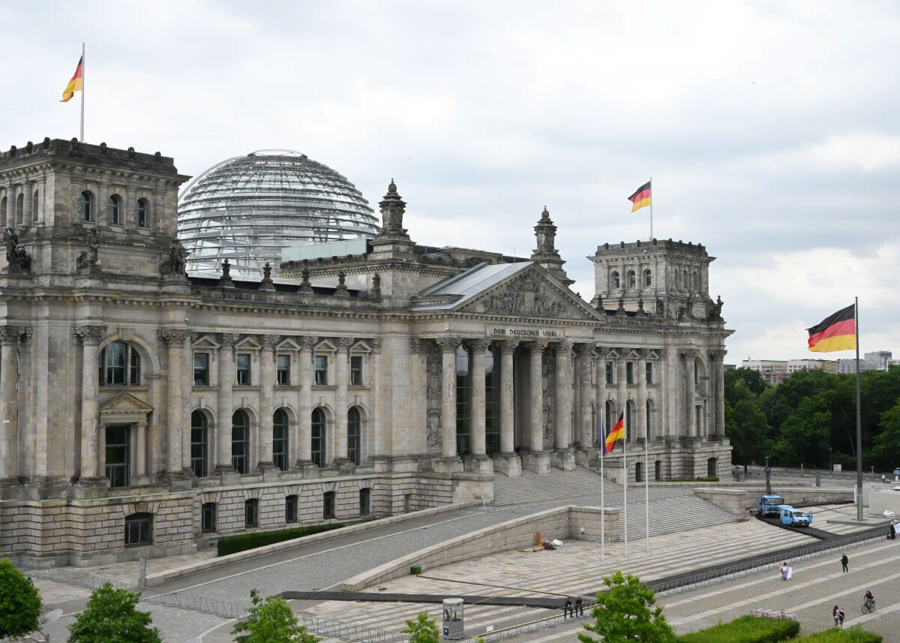
- A.den Bundestagssitz in Berlin
- B.das Bundesverfassungsgericht in Karlsruhe
- C.das Bundesratsgebäude in Berlin
- D.das Bundeskanzleramt in Berlin
Frage 56
Welches Amt gehört in Deutschland zur Gemeindeverwaltung?
- A.Pfarramt
- B.Ordnungsamt
- C.Finanzamt
- D.Auswärtiges Amt
Explanation (English)
The Ordnungsamt (public order office) is a municipal authority responsible for local public order and safety. The Pfarramt is religious, the Finanzamt is a state tax office, and the Auswärtiges Amt is the federal foreign ministry — none are municipal.
Frage 57
Wer wird meistens zur Präsidentin/zum Präsidenten des Deutschen Bundestages gewählt?
- A.die/der älteste Abgeordnete im Parlament
- B.die Ministerpräsidentin/der Ministerpräsident des größten Bundeslandes
- C.eine ehemalige Bundeskanzlerin/ein ehemaliger Bundeskanzler
- D.eine Abgeordnete/ein Abgeordneter der stärksten Fraktion
Frage 58
Wer ernennt in Deutschland die Ministerinnen/die Minister der Bundesregierung?
- A.die Präsidentin/der Präsident des Bundesverfassungsgerichtes
- B.die Bundespräsidentin/der Bundespräsident
- C.die Bundesratspräsidentin/der Bundesratspräsident
- D.die Bundestagspräsidentin/der Bundestagspräsident
Frage 59
Vor wie vielen Jahren gab es erstmals eine jüdische Gemeinde auf dem Gebiet des heutigen Deutschlands?
- A.vor etwa 300 Jahren
- B.vor etwa 700 Jahren
- C.vor etwa 1150 Jahren
- D.vor etwa 1700 Jahren
Explanation (English)
Jewish communities have existed on German territory for about 1,700 years, with documented evidence dating to Roman-era Cologne in 321 CE — among the oldest Jewish settlements in Europe north of the Alps.
Frage 60
In Deutschland gehören der Bundestag und der Bundesrat zur …
- A.Exekutive.
- B.Legislative.
- C.Direktive.
- D.Judikative.
Explanation (English)
The Bundestag and Bundesrat are both legislative bodies (Legislative) — they make laws, unlike the executive (government) or judiciary (courts).
Frage 61
Was bedeutet "Volkssouveränität"?
- A.Die Königin/der König herrscht über das Volk.
- B.Das Bundesverfassungsgericht steht über der Verfassung.
- C.Die Interessenverbände üben die Souveränität zusammen mit der Regierung aus.
- D.Die Staatsgewalt geht vom Volke aus.
Frage 62
Wenn das Parlament eines deutschen Bundeslandes gewählt wird, nennt man das …
- A.Kommunalwahl
- B.Landtagswahl
- C.Europawahl
- D.Bundestagswahl
Explanation (English)
Electing a state parliament (Landtag) is called a Landtagswahl, distinct from municipal, European, or federal elections.
Frage 63
Was gehört in Deutschland nicht zur Exekutive?
- A.die Polizei
- B.die Gerichte
- C.das Finanzamt
- D.die Ministerien
Explanation (English)
Courts belong to the judiciary (Judikative), not the executive. Police, tax offices, and ministries are all part of the executive branch.
Frage 64
Die Bundesrepublik Deutschland ist heute gegliedert in …
- A.vier Besatzungszonen.
- B.einen Oststaat und einen Weststaat.
- C.16 Kantone.
- D.Bund, Länder und Kommunen.
Explanation (English)
Germany's administrative structure has three levels: the federal government (Bund), the 16 states (Länder), and local municipalities (Kommunen).
Frage 65
Es gehört nicht zu den Aufgaben des Deutschen Bundestages, …
- A.Gesetze zu entwerfen.
- B.die Bundesregierung zu kontrollieren.
- C.die Bundeskanzlerin/den Bundeskanzler zu wählen.
- D.das Bundeskabinett zu bilden.
Frage 66
Welche Städte haben die größten jüdischen Gemeinden in Deutschland?
- A.Berlin und München
- B.Hamburg und Essen
- C.Nürnberg und Stuttgart
- D.Worms und Speyer
Explanation (English)
Berlin and Munich have Germany's largest Jewish communities today, reflecting post-reunification and post-Soviet immigration patterns.
Frage 67
Was ist in Deutschland vor allem eine Aufgabe der Bundesländer?
- A.Verteidigungspolitik
- B.Außenpolitik
- C.Wirtschaftspolitik
- D.Schulpolitik
Explanation (English)
Education policy (Schulpolitik) is primarily a state responsibility in Germany, unlike defense, foreign affairs, and much of economic policy, which are federal matters.
Frage 68
Warum kontrolliert der Staat in Deutschland das Schulwesen?
- A.weil es in Deutschland nur staatliche Schulen gibt
- B.weil alle Schülerinnen und Schüler einen Schulabschluss haben müssen
- C.weil es in den Bundesländern verschiedene Schulen gibt
- D.weil es nach dem Grundgesetz seine Aufgabe ist
Explanation (English)
State oversight of schools (Schulaufsicht) is a constitutional duty under the Basic Law, ensuring educational quality and standards nationwide.
Frage 69
Die Bundesrepublik Deutschland hat einen dreistufigen Verwaltungsaufbau. Wie heißt die unterste politische Stufe?
- A.Stadträte
- B.Landräte
- C.Gemeinden
- D.Bezirksämter
Explanation (English)
The Gemeinden (municipalities) form the lowest administrative and political level in Germany's three-tier structure of Bund, Länder, and Gemeinden.
Frage 70
Der deutsche Bundespräsident Gustav Heinemann gibt Helmut Schmidt 1974 die Ernennungsurkunde zum deutschen Bundeskanzler. Was gehört zu den Aufgaben der deutschen Bundespräsidentin/des deutschen Bundespräsidenten?
- A.Sie/Er führt die Regierungsgeschäfte.
- B.Sie/Er kontrolliert die Regierungspartei.
- C.Sie/Er wählt die Ministerinnen/Minister aus.
- D.Sie/Er schlägt die Kanzlerin/den Kanzler zur Wahl vor.
Frage 71
Wo hält sich die deutsche Bundeskanzlerin/der deutsche Bundeskanzler am häufigsten auf? Am häufigsten ist sie/er …
- A.in Bonn, weil sich dort das Bundeskanzleramt und der Bundestag befinden.
- B.auf Schloss Meseberg, dem Gästehaus der Bundesregierung, um Staatsgäste zu empfangen.
- C.auf Schloss Bellevue, dem Amtssitz der Bundespräsidentin/des Bundespräsidenten, um Staatsgäste zu empfangen.
- D.in Berlin, weil sich dort das Bundeskanzleramt und der Bundestag befinden.
Frage 72
Wie heißt die jetzige Bundeskanzlerin/der jetzige Bundeskanzler von Deutschland?
- A.Gerhard Schröder
- B.Angela Merkel
- C.Ursula von der Leyen
- D.Friedrich Merz
Frage 73
Die beiden größten Fraktionen im Deutschen Bundestag heißen zurzeit …
- A.CDU/CSU und AfD.
- B.Die Linke und Bündnis 90/Die Grünen.
- C.Bündnis 90/Die Grünen und SPD.
- D.Die Linke und CDU/CSU.
Explanation (English)
Following the 2025 federal election, CDU/CSU and AfD are the two largest parliamentary groups. Note: this is a current-affairs question — verify before the exam, as party standings change with each election.
Frage 74
Wie heißt das Parlament für ganz Deutschland?
- A.Bundesversammlung
- B.Volkskammer
- C.Bundestag
- D.Bundesgerichtshof
Explanation (English)
The Bundestag is Germany's national parliament. The Bundesversammlung only convenes to elect the President, the Volkskammer was the former East German parliament, and the Bundesgerichtshof is a court.
Frage 75
Wie heißt Deutschlands heutiges Staatsoberhaupt?
- A.Frank-Walter Steinmeier
- B.Bärbel Bas
- C.Bodo Ramelow
- D.Joachim Gauck
Explanation (English)
Frank-Walter Steinmeier is Germany's Federal President (head of state). Note: this is a current-affairs question — verify the current officeholder before the exam.
Bereit für den Ernstfall? Test yourself under real exam conditions.
Mock exams with 33 questions in 60 minutes, progress tracking and weak-area drills come with the Learning Pass.
Frage 76
Was bedeutet die Abkürzung CDU in Deutschland?
- A.Christliche Deutsche Union
- B.Club Deutscher Unternehmer
- C.Christlicher Deutscher Umweltschutz
- D.Christlich Demokratische Union
Explanation (English)
CDU stands for Christlich Demokratische Union (Christian Democratic Union), one of Germany's major political parties.
Frage 77
Was ist die Bundeswehr?
- A.die deutsche Polizei
- B.ein deutscher Hafen
- C.eine deutsche Bürgerinitiative
- D.die deutsche Armee
Explanation (English)
The Bundeswehr is Germany's armed forces (the military), not the police, a port, or a citizens' group.
Frage 78
Was bedeutet die Abkürzung SPD?
- A.Sozialistische Partei Deutschlands
- B.Sozialpolitische Partei Deutschlands
- C.Sozialdemokratische Partei Deutschlands
- D.Sozialgerechte Partei Deutschlands
Explanation (English)
SPD stands for Sozialdemokratische Partei Deutschlands (Social Democratic Party of Germany), one of Germany's oldest and largest parties.
Frage 79
Was bedeutet die Abkürzung FDP in Deutschland?
- A.Friedliche Demonstrative Partei
- B.Freie Deutschland Partei
- C.Führende Demokratische Partei
- D.Freie Demokratische Partei
Explanation (English)
FDP stands for Freie Demokratische Partei (Free Democratic Party), a liberal party in Germany.
Frage 80
Welches Gericht in Deutschland ist zuständig für die Auslegung des Grundgesetzes?
- A.Oberlandesgericht
- B.Amtsgericht
- C.Bundesverfassungsgericht
- D.Verwaltungsgericht
Explanation (English)
The Bundesverfassungsgericht (Federal Constitutional Court), located in Karlsruhe, is responsible for interpreting the Basic Law and reviewing the constitutionality of laws.
Frage 81
Wer wählt die Bundeskanzlerin/den Bundeskanzler in Deutschland?
- A.der Bundesrat
- B.die Bundesversammlung
- C.das Volk
- D.der Bundestag
Frage 82
Wer leitet das deutsche Bundeskabinett?
- A.die Bundestagspräsidentin/der Bundestagspräsident
- B.die Bundespräsidentin/der Bundespräsident
- C.die Bundesratspräsidentin/der Bundesratspräsident
- D.die Bundeskanzlerin/der Bundeskanzler
Frage 83
Wer wählt die deutsche Bundeskanzlerin/den deutschen Bundeskanzler?
- A.das Volk
- B.die Bundesversammlung
- C.der Bundestag
- D.die Bundesregierung
Frage 84
Welche Hauptaufgabe hat die deutsche Bundespräsidentin/der deutsche Bundespräsident? Sie/Er …
- A.regiert das Land.
- B.entwirft die Gesetze.
- C.repräsentiert das Land.
- D.überwacht die Einhaltung der Gesetze.
Frage 85
Wer bildet den deutschen Bundesrat?
- A.die Abgeordneten des Bundestages
- B.die Ministerinnen und Minister der Bundesregierung
- C.die Regierungsvertreter der Bundesländer
- D.die Parteimitglieder
Frage 86
Wer wählt in Deutschland die Bundespräsidentin/den Bundespräsidenten?
- A.die Bundesversammlung
- B.der Bundesrat
- C.das Bundesparlament
- D.das Bundesverfassungsgericht
Frage 87
Wer ist das Staatsoberhaupt der Bundesrepublik Deutschland?
- A.die Bundeskanzlerin/der Bundeskanzler
- B.die Bundespräsidentin/der Bundespräsident
- C.die Bundesratspräsidentin/der Bundesratspräsident
- D.die Bundestagspräsidentin/der Bundestagspräsident
Frage 88
Die parlamentarische Opposition im Deutschen Bundestag …
- A.kontrolliert die Regierung.
- B.entscheidet, wer Bundesministerin/Bundesminister wird.
- C.bestimmt, wer im Bundesrat sitzt.
- D.schlägt die Regierungschefinnen/Regierungschefs der Länder vor.
Explanation (English)
The parliamentary opposition's key role is to control and scrutinize the government — it does not appoint ministers or determine Bundesrat/state leadership.
Frage 89
Wie nennt man in Deutschland die Vereinigung von Abgeordneten einer Partei im Parlament?
- A.Verband
- B.Ältestenrat
- C.Fraktion
- D.Opposition
Explanation (English)
A Fraktion is the parliamentary group formed by members of the same party (or allied parties) in the Bundestag.
Frage 90
Die deutschen Bundesländer wirken an der Gesetzgebung des Bundes mit durch …
- A.den Bundesrat.
- B.die Bundesversammlung.
- C.den Bundestag.
- D.die Bundesregierung.
Explanation (English)
The Bundesrat is the chamber through which the states participate in federal lawmaking, giving them a voice in national legislation.
Frage 91
In Deutschland kann ein Regierungswechsel in einem Bundesland Auswirkungen auf die Bundespolitik haben. Das Regieren wird …
- A.schwieriger, wenn sich dadurch die Mehrheit im Bundestag ändert.
- B.leichter, wenn dadurch neue Parteien in den Bundesrat kommen.
- C.schwieriger, wenn dadurch die Mehrheit im Bundesrat verändert wird.
- D.leichter, wenn es sich um ein reiches Bundesland handelt.
Explanation (English)
Since state governments sit in the Bundesrat, a shift in a state election can change the Bundesrat majority, making federal governing harder if the opposition gains ground there.
Frage 92
Was bedeutet die Abkürzung CSU in Deutschland?
- A.Christlich Sichere Union
- B.Christlich Süddeutsche Union
- C.Christlich Sozialer Unternehmerverband
- D.Christlich Soziale Union
Explanation (English)
CSU stands for Christlich Soziale Union (Christian Social Union), the Bavaria-only sister party of the CDU.
Frage 93
Je mehr "Zweitstimmen" eine Partei bei einer Bundestagswahl bekommt, desto …
- A.weniger Erststimmen kann sie haben.
- B.mehr Direktkandidaten der Partei ziehen ins Parlament ein.
- C.größer ist das Risiko, eine Koalition bilden zu müssen.
- D.mehr Sitze erhält die Partei im Parlament.
Explanation (English)
The Zweitstimme (second vote) determines each party's overall share of Bundestag seats — the more second votes, the more total seats.
Frage 94
Ab welchem Alter darf man in Deutschland an der Wahl zum Deutschen Bundestag teilnehmen?
- A.16
- B.18
- C.21
- D.23
Explanation (English)
The minimum voting age for federal (Bundestag) elections in Germany is 18.
Frage 95
Was gilt für die meisten Kinder in Deutschland?
- A.Wahlpflicht
- B.Schulpflicht
- C.Schweigepflicht
- D.Religionspflicht
Explanation (English)
Compulsory schooling (Schulpflicht) applies to nearly all children in Germany — voting, confidentiality, and religion are not compulsory for children.
Frage 96
Wie kann jemand, der den Holocaust leugnet, bestraft werden?
- A.Kürzung sozialer Leistungen
- B.bis zu 100 Sozialstunden
- C.gar nicht, Holocaustleugnung ist erlaubt
- D.mit Freiheitsstrafe bis zu fünf Jahren oder mit Geldstrafe
Explanation (English)
Holocaust denial is a criminal offense in Germany under §130(3) StGB (Volksverhetzung — incitement to hatred). Anyone who publicly denies, downplays, or approves of the Nazi genocide can face up to 5 years in prison or a fine. This law reflects Germany's historical responsibility for the murder of 6 million Jews. Germany takes this very seriously — it is NOT a matter of free speech but a criminal act.
Frage 97
Was bezahlt man in Deutschland automatisch, wenn man fest angestellt ist?
- A.Sozialversicherung
- B.Sozialhilfe
- C.Kindergeld
- D.Wohngeld
Explanation (English)
Permanently employed workers automatically pay into social insurance (Sozialversicherung) — covering health, pension, unemployment, and long-term care.
Frage 98
Wenn Abgeordnete im Deutschen Bundestag ihre Fraktion wechseln, …
- A.dürfen sie nicht mehr an den Sitzungen des Parlaments teilnehmen.
- B.kann die Regierung ihre Mehrheit verlieren.
- C.muss die Bundespräsidentin/der Bundespräsident zuvor ihr/sein Einverständnis geben.
- D.dürfen die Wählerinnen/Wähler dieser Abgeordneten noch einmal wählen.
Frage 99
Wer bezahlt in Deutschland die Sozialversicherungen?
- A.Arbeitgeberinnen/Arbeitgeber und Arbeitnehmerinnen/Arbeitnehmer
- B.nur Arbeitnehmerinnen/Arbeitnehmer
- C.alle Staatsangehörigen
- D.nur Arbeitgeberinnen/Arbeitgeber
Frage 100
Was gehört nicht zur gesetzlichen Sozialversicherung?
- A.die Lebensversicherung
- B.die gesetzliche Rentenversicherung
- C.die Arbeitslosenversicherung
- D.die Pflegeversicherung
Explanation (English)
Life insurance is a private/optional product, not part of Germany's statutory social insurance system (pension, unemployment, health, and long-term care insurance).
Bereit für den Ernstfall? Test yourself under real exam conditions.
Mock exams with 33 questions in 60 minutes, progress tracking and weak-area drills come with the Learning Pass.
Frage 101
Gewerkschaften sind Interessenverbände der …
- A.Jugendlichen.
- B.Arbeitnehmerinnen und Arbeitnehmer.
- C.Rentnerinnen und Rentner.
- D.Arbeitgeberinnen und Arbeitgeber.
Frage 102
Womit kann man in der Bundesrepublik Deutschland geehrt werden, wenn man auf politischem, wirtschaftlichem, kulturellem, geistigem oder sozialem Gebiet eine besondere Leistung erbracht hat? Mit dem …
- A.Bundesverdienstkreuz
- B.Bundesadler
- C.Vaterländischen Verdienstorden
- D.Ehrentitel "Held der Deutschen Demokratischen Republik"
Explanation (English)
The Bundesverdienstkreuz (Federal Cross of Merit) is Germany's highest honor for outstanding contributions; the other options are either symbols, not awards, or from the former GDR.
Frage 103
Was wird in Deutschland als "Ampelkoalition" bezeichnet? Die Zusammenarbeit …
- A.der Bundestagsfraktionen von CDU und CSU
- B.von SPD, FDP und Bündnis 90/Die Grünen in einer Regierung
- C.von CSU, Die LINKE und Bündnis 90/Die Grünen in einer Regierung
- D.der Bundestagsfraktionen von CDU und SPD
Explanation (English)
The "traffic light coalition" (Ampelkoalition) refers to a government of SPD (red), FDP (yellow), and Bündnis 90/Die Grünen (green) — matching traffic light colors.
Frage 104
Eine Frau in Deutschland verliert ihre Arbeit. Was darf nicht der Grund für diese Entlassung sein?
- A.Die Frau ist lange krank und arbeitsunfähig.
- B.Die Frau kam oft zu spät zur Arbeit.
- C.Die Frau erledigt private Sachen während der Arbeitszeit.
- D.Die Frau bekommt ein Kind und ihr Chef weiß das.
Explanation (English)
Pregnancy is legally protected in Germany (Mutterschutz) — dismissing a woman because she is having a child is illegal, unlike the other listed conduct-related reasons.
Frage 105
Was ist eine Aufgabe von Wahlhelferinnen/Wahlhelfern in Deutschland?
- A.Sie helfen alten Menschen bei der Stimmabgabe in der Wahlkabine.
- B.Sie schreiben die Wahlbenachrichtigungen vor der Wahl.
- C.Sie geben Zwischenergebnisse an die Medien weiter.
- D.Sie zählen die Stimmen nach dem Ende der Wahl.
Explanation (English)
Election helpers (Wahlhelfer/innen) are volunteers whose main task is counting the votes after polls close — they don't write official notifications or brief the media.
Frage 106
In Deutschland helfen ehrenamtliche Wahlhelferinnen und Wahlhelfer bei den Wahlen. Was ist eine Aufgabe von Wahlhelferinnen/Wahlhelfern?
- A.Sie helfen Kindern und alten Menschen beim Wählen.
- B.Sie schreiben Karten und Briefe mit der Angabe des Wahllokals.
- C.Sie geben Zwischenergebnisse an Journalisten weiter.
- D.Sie zählen die Stimmen nach dem Ende der Wahl.
Explanation (English)
Like other election helpers, their core job is counting votes once polling ends — not writing notifications or briefing journalists.
Frage 107
Für wie viele Jahre wird der Bundestag in Deutschland gewählt?
- A.2 Jahre
- B.4 Jahre
- C.6 Jahre
- D.8 Jahre
Explanation (English)
The Bundestag's term (Legislaturperiode) is 4 years.
Frage 108
Bei einer Bundestagswahl in Deutschland darf jede/jeder wählen, die/der …
- A.in der Bundesrepublik Deutschland wohnt und wählen möchte.
- B.Bürgerin/Bürger der Bundesrepublik Deutschland ist und mindestens 18 Jahre alt ist.
- C.seit mindestens 3 Jahren in der Bundesrepublik Deutschland lebt.
- D.Bürgerin/Bürger der Bundesrepublik Deutschland ist und mindestens 21 Jahre alt ist.
Explanation (English)
Only German citizens aged 18 or older may vote in Bundestag elections — residency alone is not sufficient.
Frage 109
Wie oft gibt es normalerweise Bundestagswahlen in Deutschland?
- A.alle drei Jahre
- B.alle vier Jahre
- C.alle fünf Jahre
- D.alle sechs Jahre
Explanation (English)
Federal elections normally take place every four years, matching the Bundestag's term length.
Frage 110
Für wie viele Jahre wird der Bundestag in Deutschland gewählt?
- A.2 Jahre
- B.3 Jahre
- C.4 Jahre
- D.5 Jahre
Explanation (English)
The Bundestag's term (Legislaturperiode) is 4 years.
Frage 111
Welche Handlungen mit Bezug auf den Staat Israel sind in Deutschland verboten?
- A.die Politik Israels öffentlich kritisieren
- B.das Aufhängen einer israelischen Flagge auf dem Privatgrundstück
- C.eine Diskussion über die Politik Israels
- D.der öffentliche Aufruf zur Vernichtung Israels
Explanation (English)
Publicly calling for the destruction of Israel is a criminal offense in Germany. However, criticizing Israeli government policies, displaying Israeli flags, and discussing Israeli politics are all perfectly legal and protected by freedom of speech. The distinction is crucial: political criticism is allowed; calling for the elimination of a state is incitement and violates German law.
Frage 112
Die Wahlen in Deutschland sind …
- A.speziell.
- B.geheim.
- C.berufsbezogen.
- D.geschlechtsabhängig.
Explanation (English)
German elections are secret (geheim) — one of the five key election principles (universal, direct, free, equal, secret).
Frage 113
Wahlen in Deutschland gewinnt die Partei, die …
- A.die meisten Stimmen bekommt.
- B.die meisten Männer mehrheitlich gewählt haben.
- C.die meisten Stimmen bei den Arbeiterinnen/Arbeitern bekommen hat.
- D.die meisten Erststimmen für ihre Kanzlerkandidatin/ihren Kanzlerkandidaten erhalten hat.
Frage 114
An demokratischen Wahlen in Deutschland teilzunehmen ist …
- A.eine Pflicht.
- B.ein Recht.
- C.ein Zwang.
- D.eine Last.
Explanation (English)
Voting in Germany is a right (Recht), not a legal obligation — unlike in some countries with compulsory voting.
Frage 115
Was bedeutet "aktives Wahlrecht" in Deutschland?
- A.Man kann gewählt werden.
- B.Man muss wählen gehen.
- C.Man kann wählen.
- D.Man muss zur Auszählung der Stimmen gehen.
Explanation (English)
"Active voting right" (aktives Wahlrecht) means the right to vote — distinct from "passive voting right" (the right to stand as a candidate).
Frage 116
Wenn Sie bei einer Bundestagswahl in Deutschland wählen dürfen, heißt das …
- A.aktive Wahlkampagne.
- B.aktives Wahlverfahren.
- C.aktiver Wahlkampf.
- D.aktives Wahlrecht.
Explanation (English)
The right to vote itself is called aktives Wahlrecht (active voting right).
Frage 117
Wie viel Prozent der Zweitstimmen müssen Parteien mindestens bekommen, um in den Deutschen Bundestag gewählt zu werden?
- A.3%
- B.4%
- C.5%
- D.6%
Explanation (English)
The 5% threshold (5%-Hürde) requires parties to win at least 5% of second votes nationwide (or 3 direct constituency seats) to enter the Bundestag.
Frage 118
Wer darf bei den rund 40 jüdischen Makkabi-Sportvereinen Mitglied werden?
- A.nur Deutsche
- B.nur Israelis
- C.nur religiöse Menschen
- D.alle Menschen
Explanation (English)
The Makkabi sports clubs (named after the ancient Jewish Maccabees) are open to EVERYONE, regardless of religion, nationality, or background. There are about 40 Makkabi clubs across Germany. This question emphasizes that Jewish institutions in Germany are inclusive and part of broader German society. Makkabi Deutschland is a member of the German Olympic Sports Confederation (DOSB).
Frage 119
Wahlen in Deutschland sind frei. Was bedeutet das?
- A.Alle verurteilten Straftäterinnen/Straftäter dürfen nicht wählen.
- B.Wenn ich wählen gehen möchte, muss meine Arbeitgeberin/mein Arbeitgeber mir frei geben.
- C.Jede Person kann ohne Zwang entscheiden, ob sie wählen möchte und wen sie wählen möchte.
- D.Ich kann frei entscheiden, wo ich wählen gehen möchte.
Explanation (English)
"Free" elections mean voters decide without coercion whether to vote and for whom — not about polling location choice or employer obligations.
Frage 120
Das Wahlsystem in Deutschland ist ein …
- A.Zensuswahlrecht.
- B.Dreiklassenwahlrecht.
- C.Mehrheits- und Verhältniswahlrecht.
- D.allgemeines Männerwahlrecht.
Explanation (English)
Germany uses a mixed-member proportional system combining majority voting (Erststimme, direct constituency) and proportional representation (Zweitstimme, party lists).
Frage 121
Eine Partei möchte in den Deutschen Bundestag. Sie muss aber einen Mindestanteil an Wählerstimmen haben. Das heißt …
- A.5%-Hürde.
- B.Zulassungsgrenze.
- C.Basiswert.
- D.Richtlinie.
Explanation (English)
This minimum vote requirement is called the 5%-Hürde (5% threshold/hurdle).
Frage 122
Welchem Grundsatz unterliegen Wahlen in Deutschland? Wahlen in Deutschland sind …
- A.frei, gleich, geheim.
- B.offen, sicher, frei.
- C.geschlossen, gleich, sicher.
- D.sicher, offen, freiwillig.
Explanation (English)
German elections follow five principles: universal, direct, free, equal, and secret — here shortened to free, equal, secret.
Frage 123
Was ist in Deutschland die "5%-Hürde"?
- A.Abstimmungsregelung im Bundestag für kleine Parteien
- B.Anwesenheitskontrolle im Bundestag für Abstimmungen
- C.Mindestanteil an Wählerstimmen, um ins Parlament zu kommen
- D.Anwesenheitskontrolle im Bundesrat für Abstimmungen
Explanation (English)
The 5% threshold is the minimum share of votes (5%) a party needs nationwide to enter parliament.
Frage 124
Die Bundestagswahl in Deutschland ist die Wahl …
- A.der Bundeskanzlerin/des Bundeskanzlers.
- B.der Parlamente der Länder.
- C.des Parlaments für Deutschland.
- D.der Bundespräsidentin/des Bundespräsidenten.
Frage 125
In einer Demokratie ist eine Funktion von regelmäßigen Wahlen, …
- A.die Bürgerinnen und Bürger zu zwingen, ihre Stimme abzugeben.
- B.nach dem Willen der Wählermehrheit den Wechsel der Regierung zu ermöglichen.
- C.im Land bestehende Gesetze beizubehalten.
- D.den Armen mehr Macht zu geben.
Explanation (English)
Regular elections enable peaceful change of government based on voter majority will — a core democratic function.
Bereit für den Ernstfall? Test yourself under real exam conditions.
Mock exams with 33 questions in 60 minutes, progress tracking and weak-area drills come with the Learning Pass.
Frage 126
Was bekommen wahlberechtigte Bürgerinnen und Bürger in Deutschland vor einer Wahl?
- A.eine Wahlbenachrichtigung von der Gemeinde
- B.eine Wahlerlaubnis von der Bundespräsidentin/von dem Bundespräsidenten
- C.eine Benachrichtigung von der Bundesversammlung
- D.eine Benachrichtigung vom Pfarramt
Frage 127
Warum gibt es die 5%-Hürde im Wahlgesetz der Bundesrepublik Deutschland? Es gibt sie, weil …
- A.die Programme von vielen kleinen Parteien viele Gemeinsamkeiten haben.
- B.die Bürgerinnen und Bürger bei vielen kleinen Parteien die Orientierung verlieren können.
- C.viele kleine Parteien die Regierungsbildung erschweren.
- D.die kleinen Parteien nicht so viel Geld haben, um die Politikerinnen und Politiker zu bezahlen.
Explanation (English)
The threshold exists to prevent excessive party fragmentation, which historically made forming stable governments difficult (as in the Weimar Republic).
Frage 128
Parlamentsmitglieder, die von den Bürgerinnen und Bürgern gewählt werden, nennt man …
- A.Abgeordnete.
- B.Kanzlerinnen/Kanzler.
- C.Botschafterinnen/Botschafter.
- D.Ministerpräsidentinnen/Ministerpräsidenten.
Frage 129
Vom Volk gewählt wird in Deutschland …
- A.die Bundeskanzlerin/der Bundeskanzler.
- B.die Ministerpräsidentin/der Ministerpräsident eines Bundeslandes.
- C.der Bundestag.
- D.die Bundespräsidentin/der Bundespräsident.
Frage 130
Welcher Stimmzettel wäre bei einer Bundestagswahl gültig?
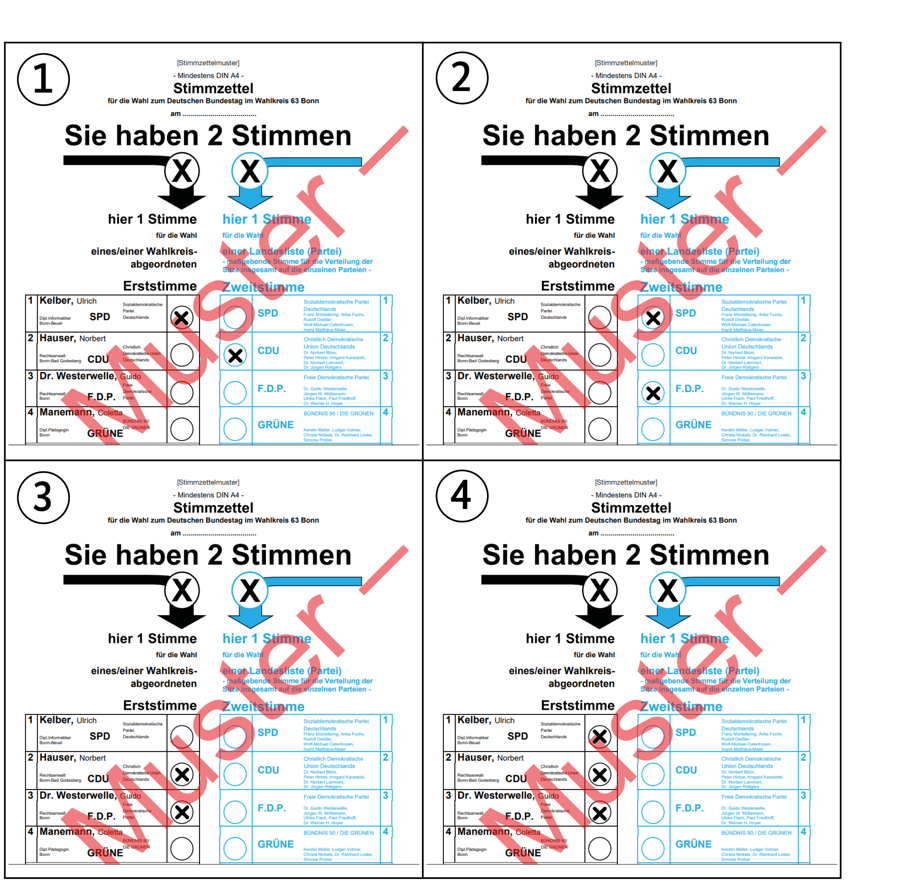
- A.1
- B.2
- C.3
- D.4
Frage 131
In Deutschland ist eine Bürgermeisterin/ein Bürgermeister …
- A.die Leiterin/der Leiter einer Schule.
- B.die Chefin/der Chef einer Bank.
- C.das Oberhaupt einer Gemeinde.
- D.die/der Vorsitzende einer Partei.
Frage 132
Viele Menschen in Deutschland arbeiten in ihrer Freizeit ehrenamtlich. Was bedeutet das?
- A.Sie arbeiten als Soldatinnen/Soldaten.
- B.Sie arbeiten freiwillig und unbezahlt in Vereinen und Verbänden.
- C.Sie arbeiten in der Bundesregierung.
- D.Sie arbeiten in einem Krankenhaus und verdienen dabei Geld.
Explanation (English)
Ehrenamtliche (voluntary) work means working unpaid in clubs, associations, or charities — a widespread and valued practice in German society.
Frage 133
Was ist bei Bundestags- und Landtagswahlen in Deutschland erlaubt?
- A.Der Ehemann wählt für seine Frau mit.
- B.Man kann durch Briefwahl seine Stimme abgeben.
- C.Man kann am Wahltag telefonisch seine Stimme abgeben.
- D.Kinder ab dem Alter von 14 Jahren dürfen wählen.
Explanation (English)
Postal voting (Briefwahl) is a legal and common way to vote in Germany — phone voting, proxy voting by a spouse, and voting under 18 are not allowed.
Frage 134
Man will die Buslinie abschaffen, mit der Sie immer zur Arbeit fahren. Was können Sie machen, um die Buslinie zu erhalten?
- A.Ich beteilige mich an einer Bürgerinitiative für die Erhaltung der Buslinie oder gründe selber eine Initiative.
- B.Ich werde Mitglied in einem Sportverein und trainiere Radfahren.
- C.Ich wende mich an das Finanzamt, weil ich als Steuerzahlerin/Steuerzahler ein Recht auf die Buslinie habe.
- D.Ich schreibe einen Brief an das Forstamt der Gemeinde.
Explanation (English)
Joining or forming a citizens' initiative (Bürgerinitiative) is the recognized, effective way to advocate for local issues like public transit in Germany.
Frage 135
Wen vertreten die Gewerkschaften in Deutschland?
- A.große Unternehmen
- B.kleine Unternehmen
- C.Selbstständige
- D.Arbeitnehmerinnen und Arbeitnehmer
Frage 136
Sie gehen in Deutschland zum Arbeitsgericht bei …
- A.falscher Nebenkostenabrechnung.
- B.ungerechtfertigter Kündigung durch Ihre Chefin/Ihren Chef.
- C.Problemen mit den Nachbarinnen/Nachbarn.
- D.Schwierigkeiten nach einem Verkehrsunfall.
Explanation (English)
Labor courts (Arbeitsgerichte) handle employment disputes such as unjustified dismissal — not utility bills, neighbor disputes, or traffic accidents.
Frage 137
Welches Gericht ist in Deutschland bei Konflikten in der Arbeitswelt zuständig?
- A.das Familiengericht
- B.das Strafgericht
- C.das Arbeitsgericht
- D.das Amtsgericht
Explanation (English)
The Arbeitsgericht (labor court) handles workplace and employment-related conflicts specifically.
Frage 138
Was kann ich in Deutschland machen, wenn mir meine Arbeitgeberin/mein Arbeitgeber zu Unrecht gekündigt hat?
- A.weiterarbeiten und freundlich zur Chefin/zum Chef sein
- B.ein Mahnverfahren gegen die Arbeitgeberin/den Arbeitgeber führen
- C.Kündigungsschutzklage erheben
- D.die Arbeitgeberin/den Arbeitgeber bei der Polizei anzeigen
Frage 139
Wann kommt es in Deutschland zu einem Prozess vor Gericht? Wenn jemand …
- A.zu einer anderen Religion übertritt.
- B.eine Straftat begangen hat und angeklagt wird.
- C.eine andere Meinung als die der Regierung vertritt.
- D.sein Auto falsch geparkt hat und es abgeschleppt wird.
Explanation (English)
A criminal trial occurs when someone commits and is charged with a crime — not for religious conversion, differing political opinions, or parking violations.
Frage 140
Was macht eine Schöffin/ein Schöffe in Deutschland? Sie/Er …
- A.entscheidet mit Richterinnen/Richtern über Schuld und Strafe.
- B.gibt Bürgerinnen/Bürgern rechtlichen Rat.
- C.stellt Urkunden aus.
- D.verteidigt die Angeklagte/den Angeklagten.
Frage 141
Wer berät in Deutschland Personen bei Rechtsfragen und vertritt sie vor Gericht?
- A.eine Rechtsanwältin/ein Rechtsanwalt
- B.eine Richterin/ein Richter
- C.eine Schöffin/ein Schöffe
- D.eine Staatsanwältin/ein Staatsanwalt
Frage 142
Was ist die Hauptaufgabe einer Richterin/eines Richters in Deutschland? Eine Richterin/ein Richter …
- A.vertritt Bürgerinnen und Bürger vor einem Gericht.
- B.arbeitet an einem Gericht und spricht Urteile.
- C.ändert Gesetze.
- D.betreut Jugendliche vor Gericht.
Frage 143
Eine Richterin/ein Richter in Deutschland gehört zur …
- A.Judikative.
- B.Exekutive.
- C.Operative.
- D.Legislative.
Explanation (English)
Judges belong to the Judikative (judiciary), the third branch of state power alongside the executive and legislature.
Frage 144
Eine Richterin/ein Richter gehört in Deutschland zur …
- A.vollziehenden Gewalt.
- B.rechtsprechenden Gewalt.
- C.planenden Gewalt.
- D.gesetzgebenden Gewalt.
Explanation (English)
Judges belong to the rechtsprechende Gewalt (judicial power) — the power to interpret and apply the law.
Frage 145
In Deutschland wird die Staatsgewalt geteilt. Für welche Staatsgewalt arbeitet eine Richterin/ein Richter? Für die …
- A.Judikative
- B.Exekutive
- C.Presse
- D.Legislative
Frage 146
Wie nennt man in Deutschland ein Verfahren vor einem Gericht?
- A.Programm
- B.Prozedur
- C.Protokoll
- D.Prozess
Explanation (English)
A court proceeding is called a Prozess (trial/legal proceeding) in German.
Frage 147
Was ist die Arbeit einer Richterin/eines Richters in Deutschland?
- A.Deutschland regieren
- B.Recht sprechen
- C.Pläne erstellen
- D.Gesetze erlassen
Explanation (English)
A judge's work is Recht sprechen — delivering rulings/administering justice, not governing or legislating.
Frage 148
Was ist eine Aufgabe der Polizei in Deutschland?
- A.das Land zu verteidigen
- B.die Bürgerinnen und Bürger abzuhören
- C.die Gesetze zu beschließen
- D.die Einhaltung von Gesetzen zu überwachen
Explanation (English)
Policing law compliance is the police's core task — defending the country is the military's job, and passing laws is parliament's.
Frage 149
Was ist ein Beispiel für antisemitisches Verhalten?
- A.ein jüdisches Fest besuchen
- B.die israelische Regierung kritisieren
- C.den Holocaust leugnen
- D.gegen Juden Fußball spielen.
Explanation (English)
Denying the Holocaust is a clear example of antisemitic behavior and is a criminal offense in Germany. Important distinctions: visiting Jewish festivals, criticizing Israeli government policies, and playing sports with or against Jewish people are all normal, acceptable activities. Criticism of Israeli government policy is NOT antisemitism. However, denying the systematic murder of 6 million Jews is both antisemitic and illegal.
Frage 150
Eine Gerichtsschöffin/ein Gerichtsschöffe in Deutschland ist …
- A.die Stellvertreterin/der Stellvertreter des Stadtoberhaupts.
- B.eine ehrenamtliche Richterin/ein ehrenamtlicher Richter.
- C.ein Mitglied eines Gemeinderats.
- D.eine Person, die Jura studiert hat.
Bereit für den Ernstfall? Test yourself under real exam conditions.
Mock exams with 33 questions in 60 minutes, progress tracking and weak-area drills come with the Learning Pass.
Bereit für den Ernstfall? Test yourself under real exam conditions.
Mock exams with 33 questions in 60 minutes, progress tracking and weak-area drills come with the Learning Pass.
Fragen zu Ihrem Bundesland
Plus 10 questions for your federal state.
Frequently asked questions
Are these the official test questions?
Yes. The questions and answer options are the official BAMF catalogue wording in German. The same catalogue is used for the Leben in Deutschland test and the Einbürgerungstest.
How many questions must I answer correctly?
17 out of 33 for the Einbürgerungstest. In the integration course, 15 correct answers earn the Leben in Deutschland certificate.
Is reading the answers enough to pass?
Reading helps you learn, but timed mock exams show whether you actually remember the answers. Most people take several mock exams before booking the real test.